![]() |
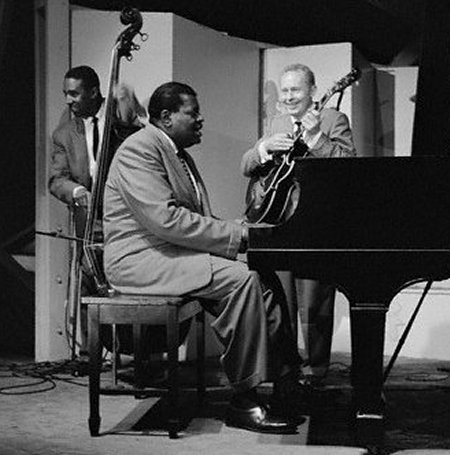
| Brown, Peterson, and Ellis |
Showing posts with label Oscar Peterson. Show all posts
Friday, March 30, 2018
Louis Armstrong & Oscar Peterson, 1957
Though his career began back in the twenties, Louis Armstrong cut some of his best albums in the 1950s—Louis Armstrong Plays W.C. Handy, his classic collaborations with Ella Fitzgerald for Verve, and Louis Under the Stars are just a few examples. Perhaps because of the sheer quantity and quality of his recordings from this era, his 1957 meeting with pianist Oscar Peterson is often forgotten or overlooked by critics, and very unjustly so. Predictably titled Louis Armstrong Meets Oscar Peterson, the album was recorded in Hollywood over the course of two separate sessions in July and October 1957 and finds Satchmo at his most laid-back and relaxed, going through a number of well-chosen standards with the inestimable help of Peterson's quartet. Armstrong's vocalizing is showcased to a greater extent than his trumpet playing (though he takes some exciting solos, such as on "Let's Fall in Love" and "Moon Song") which may be another reason that has affected the visibility of the record and its lukewarm critical reception.
But no matter, because the mood achieved by Armstrong, Peterson, guitarist Herb Ellis, bassist Ray Brown, and drummer Louis Bellson is delightful. The album opener, "That Old Feeling," sets the pace as the dates are mostly dominated by medium tempos, which works really well with tunes such as "I Was Doing All Right," "Just One of Those Things," and "Sweet Lorraine." Armstrong typically sings to the accompaniment of the Peterson trio plus Bellson, occasionally throwing in trumpet solos that aren't as brief as some critics have noted. The bluesy 5-minute reading of "Blues in the Night" is arguably one of the highlights of the sessions, which also yielded some excellent slow numbers, such as "How Long Has This Been Going On?" and "What's New?" On "There's No You," Armstrong's voice is backed only by Ellis's lovely guitar, and the track makes us wish Satchmo had recorded a whole album with Ellis, something that, alas, never happened. The slow, wistful approach to "You Go to My Head" is yet another memorable performance that has Armstrong playing the tune once through and then going into the vocals. The 1997 CD reissue fortunately offers four extra tracks ("I Get a Kick Out of You," "Makin' Whoopee," "Willow Weep for Me," and "Let's Do It (Let's Fall in Love)") that never made it to the original vinyl release but that are equally engaging. Once again, producer Norman Granz was right in pairing Louis and Oscar, and over 60 years later, the outcome of their collaboration is in need of rediscovery and reevaluation.
Labels:
Herb Ellis,
Louis Armstrong,
Louis Bellson,
Oscar Peterson,
Ray Brown
Tuesday, June 27, 2017
Two-Sentence Jazz Reviews, May-June 2017—Part II
Here's the second installment of the brief two-sentence reviews of jazz records that I heard during my recent European trip and that I originally published in my Facebook page.
The Modern Jazz Quartet at Music Inn, Vol. 2 (Atlantic, 1959)
Recorded live in Lenox, MA, in the summer of 1958, this date showcases the usual elegance of the forward-thinking Modern Jazz Quartet along with tenorist Sonny Rollins on two tracks (on Vol. 1, recorded two years earlier at the same place, it's Jimmy Giuffre that guests). The carefully chosen set list works perfectly, mixing standards with tunes by John Lewis, Milt Jackson, and Charlie Parker, and the two tracks with Rollins ("Bags' Groove" and "Night in Tunisia") are the highlights of an album that is superb all around.
Oscar Peterson Trio + One (Mercury, 1964 / Verve, 2007)
Cut for Mercury in 1964, this is one of Oscar Peterson's most relaxed, bluesiest dates of the 1960s, featuring a special guest in trumpeter Clark Terry, who plays both flugelhorn and trumpet. Peterson's piano playing is characteristically dazzling, as usual, and the comfortable interplay between his trio (Ray Brown on bass and Ed Thigpen on drums) and Terry is a joy to hear, making this an essential entry in Peterson's vast, rich discography.
Jan Lundgren Trio—Svenska Landskap (Sittel, 2003 / Fog Arts, 2017)
This 2003 gem now available for digital download and streaming finds Jan Lundgren and his trio (Mattias Svensson on bass and Morten Lund on drums) on a musical journey around Sweden via jazz versions of traditional tunes and a couple of very appropriate Lundgren originals. The playing is swift and fresh on the uptempo tracks and lyrical and introspective on the ballads, and the album as a whole won't disappoint anyone who takes a chance on it. [You may read a more detailed Jazz Flashes review about this album here.]
Freddie Hubbard—Born to Be Blue (Pablo, 1982)
This is a lovely, very recommendable late-career album by trumpeter Freddie Hubbard in a percussion-laden sextet that also features the great Harold Land on tenor sax and flute. It features some very engaging uptempo numbers (like "Joy Spring," for instance) and some typically sensitive, lyrical ballad playing such as the beautiful title track.
The Modern Jazz Quartet at Music Inn, Vol. 2 (Atlantic, 1959)
Recorded live in Lenox, MA, in the summer of 1958, this date showcases the usual elegance of the forward-thinking Modern Jazz Quartet along with tenorist Sonny Rollins on two tracks (on Vol. 1, recorded two years earlier at the same place, it's Jimmy Giuffre that guests). The carefully chosen set list works perfectly, mixing standards with tunes by John Lewis, Milt Jackson, and Charlie Parker, and the two tracks with Rollins ("Bags' Groove" and "Night in Tunisia") are the highlights of an album that is superb all around.
Oscar Peterson Trio + One (Mercury, 1964 / Verve, 2007)
Cut for Mercury in 1964, this is one of Oscar Peterson's most relaxed, bluesiest dates of the 1960s, featuring a special guest in trumpeter Clark Terry, who plays both flugelhorn and trumpet. Peterson's piano playing is characteristically dazzling, as usual, and the comfortable interplay between his trio (Ray Brown on bass and Ed Thigpen on drums) and Terry is a joy to hear, making this an essential entry in Peterson's vast, rich discography.
Jan Lundgren Trio—Svenska Landskap (Sittel, 2003 / Fog Arts, 2017)
This 2003 gem now available for digital download and streaming finds Jan Lundgren and his trio (Mattias Svensson on bass and Morten Lund on drums) on a musical journey around Sweden via jazz versions of traditional tunes and a couple of very appropriate Lundgren originals. The playing is swift and fresh on the uptempo tracks and lyrical and introspective on the ballads, and the album as a whole won't disappoint anyone who takes a chance on it. [You may read a more detailed Jazz Flashes review about this album here.]
Freddie Hubbard—Born to Be Blue (Pablo, 1982)
This is a lovely, very recommendable late-career album by trumpeter Freddie Hubbard in a percussion-laden sextet that also features the great Harold Land on tenor sax and flute. It features some very engaging uptempo numbers (like "Joy Spring," for instance) and some typically sensitive, lyrical ballad playing such as the beautiful title track.
Labels:
Clark Terry,
Ed Thigpen,
Freddie Hubbard,
Harold Land,
Jan Lundgren,
John Lewis,
Mattias Svensson,
Milt Jackson,
Modern Jazz Quartet,
Morten Lund,
Oscar Peterson,
Ray Brown,
Sonny Rollins
Monday, April 3, 2017
Charlie Parker Jams on Verve, 1952
While certain critics consider that producer Norman Granz was responsible for encouraging Charlie Parker to veer away from bebop somewhat and venture into more commercial territory, there's no doubt that Granz also helped widen Bird's horizons. It would be enough to mention the classic album Charlie Parker with Strings, in which Parker is paired with a string section to create a masterpiece that has stood the test of time and that would later be imitated by countless jazz soloists. But the producer influenced the career of the saxophonist in other ways, as well. Granz was very involved in the production and promotion of live jazz gatherings known as Jazz at the Philharmonic (JATP), all-star groups of jazz musicians who interacted in a jam-session format and who toured both the U.S. and overseas. Many of these live concerts have been preserved on tape thanks to Granz's foresight, and the producer also organized similar studio sessions with an eye to releasing them commercially. One of these, cut in July 1952, involved Parker, who was joined by a stellar cast that included Benny Carter and Johnny Hodges on alto sax, Ben Webster and Flip Phillips on tenor, Charlie Shavers on trumpet, Oscar Peterson on piano, Barney Kessel on guitar, Ray Brown on bass, and J.C. Heard on drums.
It's well known that all-star dates can be hit or miss, but from the very first bars it seems clear that this one is most definitely a winner. The length of the four cuts recorded (all of them over 13 minutes each) affords plenty of room for each soloist to show off his undeniable talents, and nobody gets in the way of anyone else. The result is a classic jam session that keeps surprising new listeners several decades after its original release. The meeting of these jazz greats is bookended by two bluesy compositions, "Jam Blues" and "Funky Blues," which work perfectly as vehicles for each participant to explore familiar musical territory in a succession of imaginative solos that allow us to experience different approaches to the blues idiom. Cole Porter's "What Is This Thing Called Love," introduced by an energetic piano solo by Peterson, is taken at a breakneck tempo and serves as an excuse for some inspired blowing by everyone. Finally, the cut simply entitled "Ballad Medley" presents the group at its mellowest and most intimate, as they tastefully run through a selection of slow standards by Jerome Kern, Matt Dennis, George Gershwin, Richard Rodgers, and others. Throughout the whole session there's that kind of electricity created by a group of excellent musicians who feel comfortable playing together and who constantly spur each other on to achieve new heights with every new solo. The album has been issued on CD as Charlie Parker Jam Session, and its contents are also available as part of the five-disc set The Complete Norman Granz Jam Sessions, which also presents other similar jams produced by Granz in the same time period. While there are other Bird recordings that one should listen to first, in my opinion this remains one of the most satisfying dates of his remarkable career.
![]() |
| Jazz producer Norman Granz |
It's well known that all-star dates can be hit or miss, but from the very first bars it seems clear that this one is most definitely a winner. The length of the four cuts recorded (all of them over 13 minutes each) affords plenty of room for each soloist to show off his undeniable talents, and nobody gets in the way of anyone else. The result is a classic jam session that keeps surprising new listeners several decades after its original release. The meeting of these jazz greats is bookended by two bluesy compositions, "Jam Blues" and "Funky Blues," which work perfectly as vehicles for each participant to explore familiar musical territory in a succession of imaginative solos that allow us to experience different approaches to the blues idiom. Cole Porter's "What Is This Thing Called Love," introduced by an energetic piano solo by Peterson, is taken at a breakneck tempo and serves as an excuse for some inspired blowing by everyone. Finally, the cut simply entitled "Ballad Medley" presents the group at its mellowest and most intimate, as they tastefully run through a selection of slow standards by Jerome Kern, Matt Dennis, George Gershwin, Richard Rodgers, and others. Throughout the whole session there's that kind of electricity created by a group of excellent musicians who feel comfortable playing together and who constantly spur each other on to achieve new heights with every new solo. The album has been issued on CD as Charlie Parker Jam Session, and its contents are also available as part of the five-disc set The Complete Norman Granz Jam Sessions, which also presents other similar jams produced by Granz in the same time period. While there are other Bird recordings that one should listen to first, in my opinion this remains one of the most satisfying dates of his remarkable career.
Labels:
Barney Kessel,
Ben Webster,
Benny Carter,
Charlie Parker,
Charlie Shavers,
Flip Phillips,
J.C. Heard,
Johnny Hodges,
Norman Granz,
Oscar Peterson,
Ray Brown
Monday, May 16, 2016
Carol Sloane's Favorite Male Vocalists
![]() |
| Shirley Horn and Carol Sloane, 1983 (Photo: Carol Sloane) |
![]() |
| Fred Astaire |
![]() |
| Bill Henderson |
Labels:
Bill Henderson,
Carol Sloane,
Frank Sinatra,
Fred Astaire,
Joe Mooney,
Joe Williams,
Nat King Cole,
Oscar Peterson,
Walter Pidgeon
Monday, April 4, 2016
Fred Astaire & Oscar Peterson, 1952
Few, if anybody, would disagree that Fred Astaire was one of the foremost dancers of the 20th century. But was he a jazz singer? Apparently, Astaire himself would laugh at the thought. He considered himself, as did most of his audiences, primarily a dancer and often derided his own abilities as a vocalist. Songwriters knew better, though, and recognized in his voice the perfect vehicle for their compositions. To be sure, his range was limited, but whatever he lacked in that department he more than made up for in phrasing and style. His singing is characterized by a rare elegance that is perfectly suited for the urbane melodies and witty lyrics of the songs of Irving Berlin, Cole Porter, and George and Ira Gershwin, among others. No wonder, then, that he introduced a large amount of tunes by these composers that have become standards, titles such as "Let's Face the Music and Dance," "Night and Day," and "Fascinatin' Rhythm," to name but a few. And these were songs that helped put the great in the Great American Songbook.
Although he claimed not to take himself seriously as a vocalist, Astaire loved jazz and jazz musicians, which is hardly surprising, since there is quite a bit of a jazz element in his tap dancing. And he actually had a particularly soft spot for a record project that he did for Verve at the request of label owner Norman Granz, entitled The Astaire Story. In his autobiography, Steps in Time, Astaire recalls these sessions with a mixture of delight and admiration for the musicians with whom he worked: "I found this [album] a most interesting and enjoyable job as Oscar Peterson, Alvin Stoller, Flip Phillips, Charles Shavers, Barney Kessel, Ray Brown and I cut these discs spontaneously on the spot without any prearranged orchestrations. This album, called The Astaire Story, with limited printings, became prominent in the collectors' item category" (301).
Yet, much more than a mere collector's item, The Astaire Story is a very revealing portrait of Astaire the jazz singer, a relaxed crooner who instinctively plays with the beat and whose phrasing is so casual that at times it almost sounds as though he were reciting the lyrics. The program is made up almost entirely of songs associated with Astaire, and the LP format allows for lengthier arrangements of the tunes, punctuated by lovely solos from Peterson on piano, Shavers on trumpet, Phillips on tenor sax, and Kessel on guitar. Astaire is clearly enjoying himself on these dates, and he sounds as much at ease with Peterson's group as Bing Crosby does on Bing with a Beat accompanied by Bob Scobey (by the way, it's really too bad that nobody ever thought to pair up Der Bingle with Peterson). The result of the Astaire-Peterson sessions, which were held in Los Angeles in December 1952, is what Will Friedwald has called the climax of Astaire's recorded legacy, among the most spontaneous music that either man ever committed to wax, a classic set that offers a definitive glimpse of Astaire having fun and singing jazz in very good company.
Although he claimed not to take himself seriously as a vocalist, Astaire loved jazz and jazz musicians, which is hardly surprising, since there is quite a bit of a jazz element in his tap dancing. And he actually had a particularly soft spot for a record project that he did for Verve at the request of label owner Norman Granz, entitled The Astaire Story. In his autobiography, Steps in Time, Astaire recalls these sessions with a mixture of delight and admiration for the musicians with whom he worked: "I found this [album] a most interesting and enjoyable job as Oscar Peterson, Alvin Stoller, Flip Phillips, Charles Shavers, Barney Kessel, Ray Brown and I cut these discs spontaneously on the spot without any prearranged orchestrations. This album, called The Astaire Story, with limited printings, became prominent in the collectors' item category" (301).
![]() |
| Oscar Peterson at the piano |
Labels:
Alvin Stoller,
Barney Kessel,
Charlie Shavers,
Flip Phillips,
Fred Astaire,
Norman Granz,
Oscar Peterson,
Ray Brown
Friday, January 8, 2016
Stuff Smith and Oscar Peterson, 1957
Though perhaps he may not be as well remembered today as fellow violinists Joe Venuti and Stéphane Grappelli, the great Stuff Smith is one of the most exciting jazzmen to ever pick up a violin. Born in Portsmouth, Ohio, in 1909, Smith was playing the instrument by age 9 in a band led by his father. In the 1920s he joined the Alphonse Trent orchestra, a territory band that operated mostly in the Texas area, and by the advent of the Swing Era, Smith had moved to New York City, where he became extremely popular with the crowds that gathered at the Onyx Club, mostly made up of musicians. His flawless sense of swing, which he claimed to have learned from none other than Louis Armstrong, soon made him one of the foremost swing violinists, and he was among the very first jazzmen to play electric violin. Smith made his first recordings around 1928, and several of them (particularly "I'Se a-Muggin'," which also features his own infectious vocals) became popular, but he didn't actually record too many albums as a leader. One of his most memorable LPs was cut in 1957 and reissued on CD a few years ago as Stuff Smith & Oscar Peterson (Poll Winners) with three extra tracks added to the six on the original album.
The quartet that accompanies Smith on the two sessions that were needed to complete the album (held in Los Angeles in March 1957) is stellar: Oscar Peterson on piano, Barney Kessel on guitar, Ray Brown on bass, and Alvin Stoller on drums. Everyone involved seems to be at ease, with all participants trading excellent solos, although Smith, Peterson, and Kessel are featured more prominently than the rest. In fact, Smith and Kessel interact seamlessly throughout both sessions, as we can clearly hear on "Soft Winds." Popular standards such as "It Don't Mean a Thing," "I Know That You Know," and "Heat Wave" are perfect vehicles to showcase Smith's virtuosity on the violin, always ably supported by Kessel, Peterson, and the rhythm section. On Duke Ellington's "Things Ain't What They Used to Be," Smith proves that his style is deeply rooted in the blues, and "In a Mellow Tone" offers a good opportunity for everyone to turn in highly inspired solos. Although Smith is known for his swinging style, the extended version of "Body and Soul" shows that he can also be sensitive and inspiring when it comes to ballads. There are even two Smith originals, "Desert Sands" and "Time and Again," that remind us that he was also very talented as a composer. This very recommendable CD also includes two tunes ("Calypso" and "I Wrote My Song") from a February 1957 date that finds Smith in a similar mood in the company of pianist Carl Perkins, bassist Red Callender, and drummer Oscar Bradley. Writing in Down Beat about this album in 1957, critic Leonard Feather said that "there is no human being on earth or in heaven who can outswing Stuff Smith." Anyone who listens to these wonderful recordings will undoubtedly agree.
Labels:
Alvin Stoller,
Barney Kessel,
Carl Perkins,
Oscar Bradley,
Oscar Peterson,
Ray Brown,
Red Callender,
Stuff Smith
Subscribe to:
Posts (Atom)


