Showing posts with label New Releases. Show all posts

Monday, July 23, 2018

New Releases: Woody Shaw Live in Tokyo, 1981

I would like to offer my gratitude to my good friend Guy Jones for alerting me to the recent release of this excellent Woody Shaw album.

The European label Elemental Music describes itself as "a new label that specializes in releasing newly discovered archival or out-of-print jazz recordings," and one of its latest issues is Tokyo '81, an outstanding concert by trumpeter Woody Shaw in Japan that had lain dormant in the vaults for several decades. Shaw, who on this occasion plays both trumpet and flugelhorn, appears in a quintet setting alongside a stellar lineup: Steve Turre on trombone and percussion, Mulgrew Miller on piano, Stafford James on bass, and Tony Reedus on drums. Though the tapes are almost forty years old, the sound is good, and the repertoire is magnificent and extremely accessible, consisting of four Shaw originals, one composition by Miller, and a tour-de-force interpretation of Thelonious Monk's well-known standard "'Round Midnight."

The opening track, an extended reading of Shaw's "Rosewood," sets the pace for the rest of the concert: the listener will be treated to Shaw's inimitable style of jazz, with lengthy versions of tunes that will afford plenty of opportunities for everyone involved to shine. This is particularly evident in the 15-minute "'Round Midnight," one of the true gems of the album, which brings to the fore the musical richness and genius of the Monk standard, which has been played so often that it's seemingly impossible to make it sound fresh and different. Yet the quintet achieves just that, mixing soft, intimate passages with others that pick up the tempo and the energy, and featuring extremely inventive solos by Shaw, Miller, and Turre. On "Apex," written by Miller, the piano is understandably more prominent, and the melody inspires Turre and Shaw to do some swift, highly imaginative soloing.

Pianist Mulgrew Miller.
The ballad "From Moment to Moment" slows down the proceedings, with Shaw playing in a melancholy, yet passionate way, ably supported by the rhythm section, and Turre exploring the lower registers of the trombone in a short but memorable solo. "Song of Songs" is arguably the most experimental of the six tunes, a fresh reading of the title track of Shaw's 1972 album that opens with a dissonant dialogue between the trumpet and the piano with Reedus playing the cymbals in the background and that clocks in at over 16 minutes of intensely expressive playing. Finally, "Theme for Maxine" is no more than a closing vamp that allows the leader to introduce the band and put an end to an excellent concert. We congratulate Elemental Music on the release of this indispensable live appearance by Shaw that would have gone otherwise unnoticed and hope that there will be many more similar issues from this label in the near future.

Trombonist Steve Turre.

Sunday, May 20, 2018

Jazz Flashes Podcast: Chris Byars on His New CD, New York City Jazz

The sound of Chris Byars's band is forcibly changing due to the fact that his guitarist, Pasquale Grasso, hitherto one of the anchors of Byars's approach to jazz, has signed an exclusive recording contract of his own and is thus leaving the group. The New York-based saxophonist adheres to the motto that one shouldn't try to replace what's irreplaceable, and so he will be modifying the sound of his combo following the guitarist's departure. That's one of the many reasons why Byars's latest CD release, New York City Jazz (SteepleChase, 2018) is a must—because it captures the sound of this particular sextet for what may well be the last time.


Cut in December 2016, the album finds Byars playing alto sax and flute in the comfortable company of Grasso on guitar, John Mosca on trombone, Stefano Doglioni on bass clarinet, Ari Roland on bass, and Stefan Schatz on drums. The program is bookended by two rather obscure compositions by Gigi Gryce ("Transfiguration" and "B.G.'s Holiday") and includes a beautiful ballad by Freddie Redd ("Dawn in the City"), two names that have influenced Byars greatly. "The General's Song" is a curiosity that the saxophonist learned from Saudi Arabian musician Tarek Abdel-Hakim during the course of one of his many trips overseas as a jazz ambassador for the U.S. State Department. The rest of the tracks are all Byars originals, and they are prime examples of his talent as a composer, as well as of the variety and depth of his influences: from the slow, intimate "Bridge of Locks," a melody that borders on the tone poem, to the jumpy "Quick Turnaround" and "Hot Dog." "Chess" is another bouncy number that references Byars's son's mastery of that ages-old game, and the Midde Eastern-sounding "No Message," one of the highlights of the set, is actually inspired on ancient traditional tune from Bahrain. On the whole, this new album by Byars is a testament to the rich music of this world-traveling saxophonist, as well as to the consummate musicianship of his magnificent band, with plenty of solos from everyone involved and a great deal of excellent bowed bass from Roland. A definite winner that serious jazz fans should seek out.


We recently caught Byars at his NYC apartment right before a recording session, and we had the chance to chat with him for about an hour for a new episode of the Jazz Flashes Podcast. Throughout the conversation we addressed the album, the impending changes in his band, and the impact that this will have on the sound of the tracks for a forthcoming new CD that we are impatiently awaiting. Hoping that the episode will be of interest to Jazz Flashes readers, it's available in its entirety here below.


Thursday, March 8, 2018

New Releases: Inspiration, by the Marc Devine Trio

After a brief hiatus, Jazz Flashes returns with a review of an excellent trio album released just a few months ago.

His first CD as a leader finds pianist Marc Devine in a trio setting and in a company in which he feels extremely comfortable and relaxed: bassist Hide Tanaka and drummer Fukushi Tainaka, whose pedigree is impeccable if we bear in mind that they've worked with illustrious names such as Junior Mance and Lou Donaldson respectively. The album, recorded in April 2017 and simply entitled Inspiration (ITI Records), amounts to an outstanding calling card that underscores Devine's straight-ahead approach, with more than a hint of bebop and hard bop but always full of swing and extremely listenable. Devine moved to NYC in 2009 after establishing a solid reputation as a top-notch jazz pianist in Austin, TX, and since settling in the Big Apple, he has been contributing to several recordings and making personal appearances at renowned clubs such as Smalls, forming productive associations with different musicians on the New York scene and now getting to cut some sides fronting his own trio.

And the music on Devine's first album as a leader is, indeed, inspired and shows the breadth of his influences. The collection opens with the trio's swinging take on Hank Mobley's perennial "Soul Station," whose bluesy riffs become the perfect vehicle for some soulful playing from the pianist. No less soulful, though with perhaps more of an accent on swing and bop, is Devine's only original composition here, "Inspiration," which does seem inspired by the hard bop sounds of Barry Harris and includes brief solos by Tanaka and Tainaka. The Great American Songbook also has its place on the album via a lightly swinging rendition of the Johnny Mercer standard, "Dream," followed by "Vignette," a lesser-known gem by Hank Jones that Devine unearths for the occasion—and rightly so. Bud Powell is yet another of Devine's inspirations, as we can hear on his lively version of Powell's "Hallucinations," which also features a marvelous bowed solo by Tanaka.

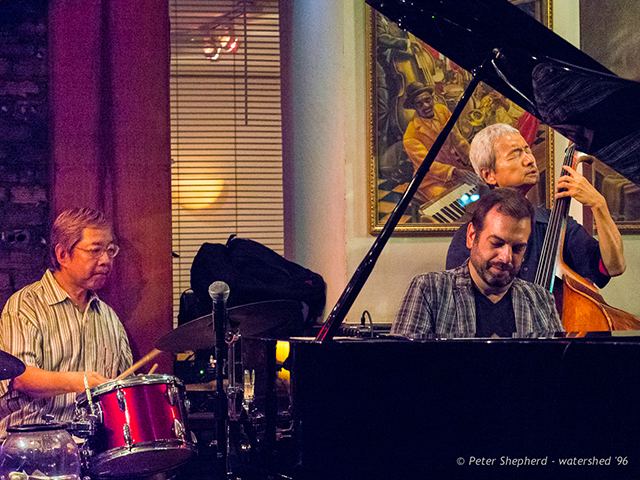
The Marc Devine Trio (Photo: Peter Shepherd)
Devine has a knack for finding the swing that lies under the melody in the unlikeliest places, as on Gerry Goffin and Carole King's "Will You Still Love Me Tomorrow," which, in Devine's hands doesn't sound anything like a Shirelles tune but swings nonchalantly in a manner that is reminiscent of Oscar Peterson or Erroll Garner. Similarly, Elvis Presley's ballad, "Love Me Tender," is another seemingly odd choice that somehow works perfectly when taken at an ultra-slow pace that renders it almost minimalist. Osie Johnson's "Osmosis" is the exact opposite: as vertiginous as it gets on the album, this is an extremely appropriate closer that leaves the listener hungry for more. In short, Marc Devine's debut album at the helm of his trio lives up to its title, and with its right doses of swing and bop, the excellent rapport between the musicians, and the variety of the tune selections, it's one of the best and most engaging trio albums I've heard in a very long time.

Further Information

For more information about the Marc Devine Trio, including upcoming live gigs, please visit Devine's website here.