![]() |
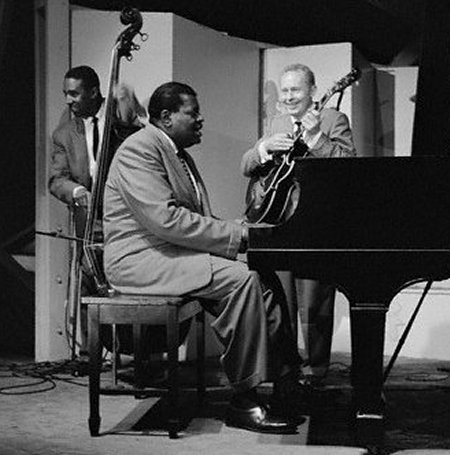
| Brown, Peterson, and Ellis |
Showing posts with label Louis Bellson. Show all posts
Friday, March 30, 2018
Louis Armstrong & Oscar Peterson, 1957
Though his career began back in the twenties, Louis Armstrong cut some of his best albums in the 1950s—Louis Armstrong Plays W.C. Handy, his classic collaborations with Ella Fitzgerald for Verve, and Louis Under the Stars are just a few examples. Perhaps because of the sheer quantity and quality of his recordings from this era, his 1957 meeting with pianist Oscar Peterson is often forgotten or overlooked by critics, and very unjustly so. Predictably titled Louis Armstrong Meets Oscar Peterson, the album was recorded in Hollywood over the course of two separate sessions in July and October 1957 and finds Satchmo at his most laid-back and relaxed, going through a number of well-chosen standards with the inestimable help of Peterson's quartet. Armstrong's vocalizing is showcased to a greater extent than his trumpet playing (though he takes some exciting solos, such as on "Let's Fall in Love" and "Moon Song") which may be another reason that has affected the visibility of the record and its lukewarm critical reception.
But no matter, because the mood achieved by Armstrong, Peterson, guitarist Herb Ellis, bassist Ray Brown, and drummer Louis Bellson is delightful. The album opener, "That Old Feeling," sets the pace as the dates are mostly dominated by medium tempos, which works really well with tunes such as "I Was Doing All Right," "Just One of Those Things," and "Sweet Lorraine." Armstrong typically sings to the accompaniment of the Peterson trio plus Bellson, occasionally throwing in trumpet solos that aren't as brief as some critics have noted. The bluesy 5-minute reading of "Blues in the Night" is arguably one of the highlights of the sessions, which also yielded some excellent slow numbers, such as "How Long Has This Been Going On?" and "What's New?" On "There's No You," Armstrong's voice is backed only by Ellis's lovely guitar, and the track makes us wish Satchmo had recorded a whole album with Ellis, something that, alas, never happened. The slow, wistful approach to "You Go to My Head" is yet another memorable performance that has Armstrong playing the tune once through and then going into the vocals. The 1997 CD reissue fortunately offers four extra tracks ("I Get a Kick Out of You," "Makin' Whoopee," "Willow Weep for Me," and "Let's Do It (Let's Fall in Love)") that never made it to the original vinyl release but that are equally engaging. Once again, producer Norman Granz was right in pairing Louis and Oscar, and over 60 years later, the outcome of their collaboration is in need of rediscovery and reevaluation.
Labels:
Herb Ellis,
Louis Armstrong,
Louis Bellson,
Oscar Peterson,
Ray Brown
Tuesday, July 5, 2016
Count Basie in Stockholm with Louis Bellson, 1962
In 1962, drummer Sonny Payne was involved in a car accident and had to bow out of the Count Basie orchestra's impending tour of Sweden, forcing the Count to find a suitable replacement quickly. And a suitable bench man he did find when he hired the great Louis Bellson for the tour, which took the band all over Sweden, playing mostly in small towns but also in bigger cities like Gothenburg, Malmö, and of course, Stockholm. In the Swedish capital, Basie and his crew played a five-night engagement at Gröna Lunds Tivoli, which included both a nightly concert and a session strictly for dancers. Someone at Roulette Records had the good presence of mind to tape some of the music played at these sessions for dancers, and some of these tracks appeared on Basie in Sweden, which turned out to be Basie's final LP for the label—and a very enjoyable one at that.
At these more informal sessions, the band sounds extremely relaxed, inspired to take exciting solos, and properly propelled by Bellson's high-octane drumming. Though perhaps not quite as explosive as Payne, Bellson has a very personal flair for swinging, and his drumming always sounds classy and elegant. This later edition of the Atomic Basie band features a lineup full of legendary sidemen, among them reedmen Frank Wess and Frank Foster, trumpeters Thad Jones and Benny Bailey, trombonists Benny Powell and Ake Persson, and guitarist Freddie Green. As one would expect, there's plenty of swing to go around, from the album opener, "Little Pony," to its closer, "Peace Pipe," and many others in between ("Corner Pocket," "Splanky," "Four, Five Six"). It's almost a cliche now to describe the Basie outfit as a well-oiled swinging machine, and these recordings provide ample proof that there's a lot of truth behind that cliche. But the band can also take it easy whenever necessary, as on the rather subdued reading of Neal Hefti's "Plymouth Rock" or on the standard "April in Paris," the latter with some fine contributions by Thad Jones. Duke Ellington's "In a Mellotone" is another highlight of a live album full of highlights, and Basie even has room to spotlight vocalist Irene Reid's bluesy tribute to Bessie Smith on "Backwater Blues." The 1991 CD reissue, which has some very informative liner notes by Basie bio-discographer Chris Sheridan, includes four previously unreleased tracks, but the music is so good that it still leaves you hungry for more from this unique teaming of Basie and Bellson.
![]() |
| Drummer Louis Bellson |
Labels:
Ake Persson,
Benny Bailey,
Benny Powell,
Count Basie,
Frank Foster,
Frank Wess,
Freddie Green,
Irene Reid,
Live Jazz,
Louis Bellson,
Sonny Payne,
Thad Jones
Subscribe to:
Posts (Atom)


