A companion site to 'The Vintage Bandstand,' this is a series of brief posts about all kinds of good jazz, written and published by Anton Garcia-Fernandez in Martin, Tennessee, U.S.A.
Not that Sarah Vaughan had quit swinging by 1967, but she had been concentrating on more pop-oriented albums such as Viva! Vaughan, Sarah Vaughan Sings the Mancini Songbook, Pop Artistry, and The New Scene in 1965-66 alone. For her final Mercury outing, she was back on jazz territory with a swinging big band session that was issued under the very appropriate title of Sassy Swings Again. The psychedelic look of the album's cover has more to do with the time period than with the music in its grooves. For this project, Vaughan enlisted the help of four different arrangers—Bob James, J.J. Johnson, Manny Albam, and Thad Jones—but the results are surprisingly consistent, as though only one arranger had been employed. The sessions, held over two days in January 1967, included such top jazzmen as Kai Winding, Freddie Hubbard, Joe Newman, Benny Golson, and Phil Woods, so the sound is powerful and exciting. In the company of these outstanding musicians, Sassy was definitely swinging again.
The energy is evident from the very first track, a scat-filled version of "Sweet Georgia Brown," taken at a characteristically breakneck tempo. The song selection is full of classic standards ("S'posin'," "I Want to Be Happy," "Take the A Train"), all of them sung at a medium or fast pace, without much room for ballads. Vaughan even extracts some swing out of Irving Berlin's "All Alone," which Frank Sinatra had recently used as the title track of one of his lesser-known slow albums, and digs deep for some rarely heard numbers like Richard Rodgers's "The Sweetest Sounds," Cy Coleman and Carolyn Leigh's "On the Other Side of the Tracks," and Alan Jay Lerner's "I Had a Ball." Sassy's elegantly swinging reading of the Tony Bennett hit "I Left My Heart in San Francisco" is impressive, and she also has a chance to prove that she can tackle a blues standard convincingly on "Everyday I Have the Blues," one of the standout tracks on the LP. This isn't Vaughan's best-remembered album (in fact, it wasn't until a Facebook friend recently alerted me to it that I was even reminded that it existed; thanks Luis!) but it's a wholly satisfying jazz date with some high-class sidemen that deserves a serious listen.
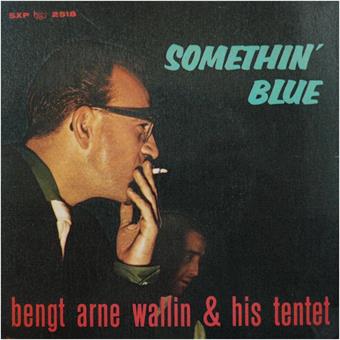
I just heard from my Stockholm-based friend, Guy Jones, founder and president of Friends of Jan Lundgren, the fan club of pianist Jan Lundgren, that legendary Swedish trumpeter Bengt-Arne Wallin passed away on November 23. He was 89 years old, and even though he's far from a household name in the United States, he devoted his whole life to music and was extremely well respected in Scandinavian jazz circles. Born in Linköping, Wallin showed an interest in music at an early age and concentrated on the trumpet and the flugelhorn. He spent much of the 1950s and '60s playing and recording alongside such European jazz luminaries as Arne Domnérus and Lars Gullin, and when American tenor saxophonist Benny Golson made some recordings with Scandinavian jazzmen, Wallin was one of the musicians who were called in for the sessions.
Like pianist Jan Johansson, Wallin became interested in exploring the relationship between Swedish folk music and jazz, and his recordings in this vein garnered him much acclaim in his homeland. Besides his work as a trumpeter, Wallin was also valued as an arranger and composer (he wrote music for films and TV productions), and he also spent two decades as a music teacher at Stockholm's Musikhögskolan. Throughout his long and successful career, Wallin acted as mentor to younger musicians such as trombonist Nils Landgren, who, upon hearing of Wallin's passing, called him "my greatest mentor, both as a musician and as a human being." Pianist Jan Lundgren also remembered Wallin on his Facebook page, reflecting on how thankful he was to have had the chance to work with the great trumpeter, whom he considers "one of the finest arrangers we have had." I must admit that the only recordings I've ever heard by Wallin are the ones he made in 1959 and 1960 as part of an octet led by saxophonist Lars Gullin, which can be found in the Gullin 4-CD set, Portrait of the Legendary Baritone Saxophonist: The Complete Recordings 1956-1960 (Fresh Sound Records). On these, of course, Gullin is the star and the spotlight is mostly on him, but Wallin comes across as a very dependable accompanist in ensemble passages, and on "Blue Mail" and "Baritonome," for example, he even gets to contribute some highly original, exciting solos that make you wish he'd been featured a little more prominently. On the strength of these sides alone, there's little doubt that Wallin is a musician whose recorded legacy is worth exploring further.