A companion site to 'The Vintage Bandstand,' this is a series of brief posts about all kinds of good jazz, written and published by Anton Garcia-Fernandez in Martin, Tennessee, U.S.A.
To paraphrase Irving Berlin's lyric, it's time to start the New Year right with a new episode of the Jazz Flashes Videocast. On this occasion, I briefly discuss three of the gifts I received this holiday season, as well as two purchases I made myself while spending a few days in North Carolina with my family. The albums I review in the video are the following: Dodo Greene's My Hour of Need - This was one of the best discoveries I've made lately—an album by the vastly under-recorded soul jazz vocalist Dodo Greene, who unfortunately only cut a couple of dates in the early 1960s. On this 1962 Blue Note album she is backed by a stellar cast that includes the Ike Quebec Quintet. Hank Jones & Frank Wess's Hank and Frank - The first volume of a 2003 encounter by these two jazz greats. If you listen to this one, you'll definitely be looking for its companion volume! Miles Davis at Newport 1953-1973 - The fourth installment of Columbia-Legacy's ongoing Miles Davis bootleg series. These four CDs span twenty years of appearances by Davis in different settings at the famed Newport Jazz Festival.
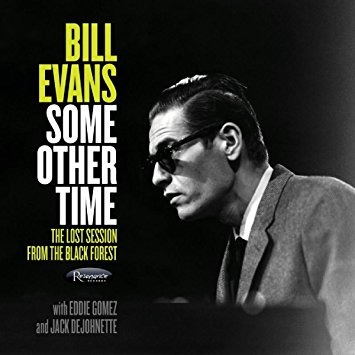
Bill Evans's Some Other Time: The Lost Session from the Black Forest - A recent release by Resonance Records of some late-1960s Bill Evans trio recordings made in Germany and previously unissued. Larry Young in Paris. The ORTF Recordings - Yet another great Resonance release, featuring some 1960s sessions by the lesser-known organist and pianist made for French radio. You may find this episode of the Jazz Flashes Videocast on YouTube (click on the top-right corner of this website to access our YouTube channel, which includes several other videos) and also here below. Happy New Year to all the readers of Jazz Flashes!
Despite the title of the only album Pepper Adams cut for Regent (a subsidiary of Savoy Records), 1957's The Cool Sound of Pepper Adams, the baritone saxophonist always favored a decidedly hard bop approach over the cool sounds of West Coast jazz. But no doubt the popularity of the so-called cool school at the time was what led the label to use that title. The disc is absolutely fantastic, comprised of four long tracks (none of them shorter than seven minutes) that offer ample room for lengthy solos by everyone involved, and the music flows freely and easily. Closely linked with the Detroit music scene of the 1940s and '50s, Adams was born in 1930 in Highland Park, MI, and went through a difficult childhood before finding his way in life through music. He played tenor sax and clarinet before settling on the baritone and eventually becoming an innovator on that instrument with a hard-driving style that set him apart from cooler practitioners such as Gerry Mulligan and Serge Chaloff. Throughout his long career, Adams recorded in countless different settings, from big bands to small groups, and alongside too many jazz legends to keep track of all of them. Some of his most satisfying collaborations include recordings with Thad Jones, Charles Mingus, Oliver Nelson, Ben Webster, John Coltrane, and Jimmy Knepper, though these are merely a few examples among several other that could be named.
The Cool Sound is one of Adams's earliest recorded efforts, yet this quintet session cut in November 1957 perfectly illustrates his direct, powerful approach to the baritone sax and shows how starkly different his style is from that of better-known contemporary Mulligan. Accompanied by Hank Jones on piano, George Duvivier on bass, Elvin Jones on drums, and Bernard McKinney on euphonium, an instrument that is seldom used in a jazz context, Adams uses the four tunes as vehicles to prove that the baritone can be used in highly inventive ways in a bop context without necessarily having to take a trip out west. What's more, though the accent is on Adams's baritone, the generous length of the four tracks allows the rest of the band to shine as well, and McKinney's euphonium sounds surprisingly effective. As implied by its title, "Bloos, Blooze, Blues" is a blues-inflected melody that shows Adams is extremely comfortable playing in that idiom. The next two compositions (Barry Harris's "Seein' Red" and McKinney's "Like... What Is This?") pick up the pace somewhat and include lovely solos by all participants. Adams's own "Skippy" is a strong closer, based on an interesting melody introduced in unison by the baritone sax and the euphonium and then taken as an excuse for some colorful improvisation by Duvivier, Hank Jones (very restrained and elegant), Adams, and McKinney. The whole album is extremely enjoyable, one of those cases where the whole is indeed as satisfying as the sum of its parts. After a prolific career and some constant tireless touring throughout the United States, Europe, and other corners of the world, Pepper Adams died from lung cancer in New York City in 1986. His large recorded legacy is impressive to say the least and won't disappoint anyone who decides to dig deep into it—and this late-'50s outing isn't a bad place to start at all!
The Leonard Feather-produced album Keepin' Up with the Joneses, cut in 1958 for MGM, is one of the most obscure dates by a quartet that called itself The Jones Brothers. In reality, only three of the four participants (trumpeter Thad Jones, pianist Hank Jones, and drummer Elvin Jones) were brothers; bassist Eddie Jones simply shared their last name, yet the idea of billing the band as brothers probably was a gimmick that came from Feather himself, which would perhaps explain the scarcity of information about the identity of the quartet members on the cover of the LP. The choice of material also seems to be mandated in part by yet another inside joke: as the cover reads, the band is "playing the music of Thad Jones and Isham Jones." While it makes sense that the date would include compositions by Thad Jones, who plays flugelhorn here, the three tunes by Isham Jones, a prominent songwriter and bandleader of the 1920s and '30s, were most likely chosen because of his last name. Of course, like Eddie Jones, Isham wasn't related to the three Jones brothers, but whatever the reason behind the choice, the three selections written by him (all of them included on side B) are dependable standards that are among the highlights of the album, in particular "It Had to Be You," which features a lengthy piano solo by Hank. "On the Alamo" is taken at an agreeable, easy-swinging tempo and, again, is clearly dominated by Hank's piano before Thad even gets a chance to play his muted flugelhorn part. Another memorable moment is the closer, "There Is No Greater Love," which becomes the perfect vehicle for an intimate musical dialogue between Thad and Hank.
Thad Jones wrote many of the tunes for this date
The rest of the tunes are all Thad Jones originals, and accordingly, Thad's flugelhorn is most often spotlighted, as in the album opener, "Nice and Nasty," a blues-tinged melody that lends itself easily to improvisation and even leaves some room for Eddie Jones to take a brief bass solo. "Keepin' Up with the Joneses" is based on a very catchy riff introduced by the trumpet and repeated by the piano. Both Thad and Hank have ample room to shine here, Hank showing his versatility by switching to organ halfway through the performance. "Three and One," whose title possibly makes reference to the fact that Eddie Jones isn't actually kin to the other three Jones boys, is a lovely mid-tempo number, and "Sput 'n' Jeff" features Thad's rather understated flugelhorn in contrast with Hank's quick, rippling piano runs. The brief dialogues between Elvin's unusually soft drumming and Eddie's noticeably quiet bass add freshness to the latter track. Though not always easy to locate, this forgotten session was reissued on CD back in 1999 and is particularly interesting and unique because the three Jones brothers didn't record together very often in the years following this date.
I recently published here a post about the 1956 collaboration between Duke Ellington and Rosemary Clooney that resulted in the excellent Columbia album Blue Rose. About 14 years later, in August and September of 1970, two of the musicians that were a part of the Ellington band during those sessions with Clooney, Paul Gonsalves and Ray Nance, came together in New York City for the two dates that produced the album Just A-Sittin' and A-Rockin', which was fortunately reissued on CD by the Black Lion label in 1990, though that release isn't always easy to find. Born in Chicago in 1913, Nance learned to play the piano and the violin before taking up the trumpet, as he himself told critic Stanley Dance, because "I wanted to hear myself on a louder instrument in a way I couldn't do with the violin in the orchestra." After working with Earl Hines and Horace Henderson, Nance joined Ellington in 1940 and stayed until the 1960s, distinguishing himself as a master of the growling trumpet, but also as a violinist and a Louis Armstrong-influenced singer. Gonsalves, who was born in Boston in 1920 and whose parents came originally from the islands of Cape Verde, was about seven years younger than Nance and didn't become an Ellingtonian until 1950, although by then he'd already made a name for himself via his work with orchestras led by Count Basie and Dizzy Gillespie. The warmth of his tone on the tenor saxophone was undoubtedly inspired by Coleman Hawkins and Ben Webster, but he developed a recognizable style that can be heard at its very best on an epic solo he took during Ellington's version of "Diminuendo and Crescendo in Blue" at the 1956 Newport Jazz Festival.
The multitalented Ray Nance
As I've mentioned, the Nance-Gonsalves colaboration we're discussing today materialized over the course of two different sessions. On the first of these dates, they're joined by Raymond Fol on piano, Al Hall on bass, and Oliver Jackson on drums, and the quintet goes through a very appealing selection of tunes, mostly written by the Duke and Billy Strayhorn. Nance alternates between trumpet and violin and even offers a sample of his tuneful, gravelly singing on the title track of the album and on the light-hearted "I'm in the Market for You." Gonsalves plays some very lyrical, breathy, Webster-infused tenor saxophone throughout the whole date. For the second session, the group is augmented by Norris Turney on alto saxophone and flute, and the great Hank Jones replaces Fol at the keyboard. That second meeting spawned "B.P. Blues," a lovely Ellington-penned blues tune that kicks off the album, but for the most part, the numbers chosen, such as "Don't Blame Me" and a very beautiful reading of Matt Dennis's "Angel Eyes," are standards not written by Ellington or Strayhorn. The CD reissue, which reprints the original liner notes by producer Alan Bates, is rounded up by two selections ("I Cover the Waterfront" and "Stompy Jones") not included in the original LP. Although this marvelous session is currently out of print on CD, until someone decides to make it more easily available once again, it's certainly well worth picking up a used copy—that is, in the event that one is lucky enough to find the disc at a reasonable price.
As wonderful as the 1963 album John Coltrane and Johnny Hartman is (undoubtedly one of the all-time classic jazz vocal albums) my introduction to the unique sound of Johnny Hartman's voice came via another record, one he cut for Impulse two years later, in 1965—The Voice That Is! As soon as I heard it, I was hooked, and I only discovered Hartman's timeless collaboration with Trane a little later and was similarly awestruck. Hartman was essentially a jazz-inflected pop singer, a stylistic heir to Billy Eckstine by way of Frank Sinatra, to whom the title of The Voice That Is unequivocally alludes. The smooth, deep voice reminds us of Mr. B., while his way with a ballad is clearly influenced by the young Mr. S. Indeed, until he cut his celebrated LP with John Coltrane, Hartman had been trying to make it primarily as a balladeer, straddling the fence between jazz and pop, as we can hear on his excellent (and quite underrated) debut album, Songs from the Heart (Bethlehem, 1955), with Ralph Sharon on piano and Howard McGhee on trumpet. Before that, he had worked with Earl Hines and Dizzy Gillespie, and up until signing with Impulse in the early 1960s, he had made records with strings and with the likes of Erroll Garner and Perez Prado. But then he co-led that famous session with Coltrane, and everything changed for him: all of a sudden, Hartman's star began to rise, but he was seen primarily as a jazzman now, not a pop singer, which opened many doors for him, but at the same time closed some others. There were many venues that began booking him as a jazz vocalist, but that left him out of other venues that wouldn't get anywhere near a singer associated with jazz.
Fortunately, the success of John Coltrane and Johnny Hartman prompted Impulse to record Hartman more extensively, and The Voice That Is, cut at Rudy Van Gelder's studio in September 1964, is actually his third outing for the label. The LP was the product of two different sessions, both produced by Bob Thiele. The first one took place on September 22 and finds Hartman accompanied by Hank Jones on piano, Barry Galbraith on guitar, Richard Davis on bass, and Osie Johnson on drums. The setting here is rather similar to what we can hear on his previous album, I Just Dropped By to Say Hello, and the songs are mostly intimate ballads ("My Ship,""These Foolish Things,""It Never Entered My Mind") that Hartman handles with ease and elegance. There's a mid-tempo number, "The More I See You," that proves Hartman can swing when he wants to, and a lovely version of Bill Evans's "Waltz for Debby" (Gene Lees's beautiful lyrics sound tailor-made for Hartman) that is one of the highlights of the album and makes me wish that the vocalist had done an LP with Evans, like Tony Bennett and Monica Zetterlund did. The same quartet appears again on the second session, held on September 24, except for the fact that Bob Hammer, who handles the arrangements as well, replaces Hank Jones on piano. Also, the lineup is augmented with Dick Hafer on reeds, Phil Kraus on marimba, Howard Collins on guitar, and Willie Rodriguez on percussion, and so the rhythms become more unusually exotic, as on the catchy "The Day the World Stopped Turning," which features a beautiful flute solo by Hafer, and Henry Mancini's lesser-known "A Slow Hot Wind," whose very charming melody is subtly punctuated by Kraus's marimba. On this session Hartman took a stab at more contemporary songs, such as Ennio Morricone's "Funny World,"Bart Howard's "Let Me Love You," and "Sunrise, Sunset," from Fiddler on the Roof, which closes the album. Frank Loesser's "Joey. Joey, Joey" is another good example of a tune that doesn't usually turn up on vocal jazz albums (Sammy Davis, Jr. did it as a duet with Brazilian guitarist Laurindo Almeida, for instance) but then The Voice That Is simply isn't a typical vocal jazz record. Hartman made a few more recordings in the 1960s, '70s, and '80s, before his passing in 1983, including some excellent Coltrane-inspired sessions in Japan, yet he sadly never achieved the kind of recognition that his talent should have warranted. Luckily, we still have his albums, and The Voice That Is remains one of his freshest and most satisfying efforts.
Recommended Reading
The only book-length biography of Johnny Hartman currently available is Gregg Akkerman's excellent The Last Balladeer: The Johnny Hartman Story (Scarecrow Press, 2012). You may find it here.
Johnny Hartman Online Discography
Mr. Akkerman and my friend Noal Cohen collaborated on a very thorough Johnny Hartman discography, which you may find here.