Showing posts with label Louis Armstrong. Show all posts

Friday, March 30, 2018

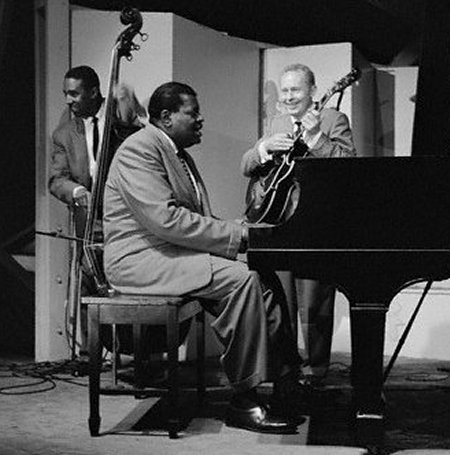
Louis Armstrong & Oscar Peterson, 1957

Though his career began back in the twenties, Louis Armstrong cut some of his best albums in the 1950s—Louis Armstrong Plays W.C. Handy, his classic collaborations with Ella Fitzgerald for Verve, and Louis Under the Stars are just a few examples. Perhaps because of the sheer quantity and quality of his recordings from this era, his 1957 meeting with pianist Oscar Peterson is often forgotten or overlooked by critics, and very unjustly so. Predictably titled Louis Armstrong Meets Oscar Peterson, the album was recorded in Hollywood over the course of two separate sessions in July and October 1957 and finds Satchmo at his most laid-back and relaxed, going through a number of well-chosen standards with the inestimable help of Peterson's quartet. Armstrong's vocalizing is showcased to a greater extent than his trumpet playing (though he takes some exciting solos, such as on "Let's Fall in Love" and "Moon Song") which may be another reason that has affected the visibility of the record and its lukewarm critical reception.


Brown, Peterson, and Ellis
But no matter, because the mood achieved by Armstrong, Peterson, guitarist Herb Ellis, bassist Ray Brown, and drummer Louis Bellson is delightful. The album opener, "That Old Feeling," sets the pace as the dates are mostly dominated by medium tempos, which works really well with tunes such as "I Was Doing All Right," "Just One of Those Things," and "Sweet Lorraine." Armstrong typically sings to the accompaniment of the Peterson trio plus Bellson, occasionally throwing in trumpet solos that aren't as brief as some critics have noted. The bluesy 5-minute reading of "Blues in the Night" is arguably one of the highlights of the sessions, which also yielded some excellent slow numbers, such as "How Long Has This Been Going On?" and "What's New?" On "There's No You," Armstrong's voice is backed only by Ellis's lovely guitar, and the track makes us wish Satchmo had recorded a whole album with Ellis, something that, alas, never happened. The slow, wistful approach to "You Go to My Head" is yet another memorable performance that has Armstrong playing the tune once through and then going into the vocals. The 1997 CD reissue fortunately offers four extra tracks ("I Get a Kick Out of You," "Makin' Whoopee," "Willow Weep for Me," and "Let's Do It (Let's Fall in Love)") that never made it to the original vinyl release but that are equally engaging. Once again, producer Norman Granz was right in pairing Louis and Oscar, and over 60 years later, the outcome of their collaboration is in need of rediscovery and reevaluation.


Tuesday, May 24, 2016

Victoria Spivey: Multitalented Blues and Jazz Songstress

Houston-born Victoria Spivey was a woman of many talents. She could sing, write songs, and play several instruments, among them the piano, the organ, and the ukulele. Though there was a hiatus in the 1950s, her recording career spans about five decades, from 1926, when she cut her first record, "Black Snake Blues," up until the 1970s. Fortunately for us, she was among the many blues performers who were rediscovered during the folk revival of the '50s and '60s, and she made quite a few recordings for her own Spivey Records label late in her career, including such interesting albums as Songs We Taught Your Mother (Alberta Hunter is also on this one) and The Queen and Her Knights, with Lonnie Johnson, Little Brother Montgomery, and Memphis Slim. Spivey influenced many performers in the '60s, among them Bob Dylan (who plays harmonica on one of her albums), Paul Butterfield, and Elvin Bishop, but her reputation as a blues singer rests primarily on the many fine recordings she committed to wax between the '20s and the '40s. On these, her attractive voice shows that she's been listening to both Bessie Smith and Annette Hanshaw, and, as is the case with the Empress, Spivey's brand of blues has a strong jazz component (great jazzmen like Henry Red Allen appear on some of her sides), and many of her records feature hot solos and risque lyrics.


The sexually suggestive nature of many of Spivey's lyrics shouldn't be surprising when we bear in mind that she came out of a '20s Houston scene that often forced performers to play hangouts of ill repute. In the late 1920s, before concentrating on a career as a recording artist, Spivey tried songwriting, but after moving to New York City, she soon became a regular in the studios of major labels such as Decca, Vocalion, and Victor. Her discs proved quite popular with the record-buying public, and this led to several roles in black musical revues. Spivey also found time to tour and record with bands led by Louis Armstrong, but at some point she decided to quit secular music, her successful recording career, and the small nightclubs where she was performing to concentrate on singing only religious material in church. No examples of this stage of her career seem to exist, but as mentioned, she went back into the recording studio quite often in the '60s and '70s before her death, which occurred on October 3, 1976 in New York. Some of her folk-boom albums (Songs We Taught Your Mother, The Blues Is Life) are available on CD, and luckily, the Document label has reissued her classic sides chronologically. A good sample of her '20s and '30s recordings is The Victoria Spivey Collection 1926-37 (Acrobat), a very recommendable two-disc introduction to her best work. Although she's perhaps not talked about as much as other classic blues singers, Victoria Spivey produced a highly consistent body of work that should satisfy both blues and jazz enthusiasts.


Saturday, November 21, 2015

Bing Crosby and Some Jazz Friends

Back in 2010 I began The Vintage Bandstand with a post about Bing Crosby, so it's only fitting that I'd start this new blog talking about Crosby as well, particularly because in my early teens, Der Bingle was one of my main gateways into jazz. Crosby, who is mostly known to the general public for his Christmas recordings these days (which is a sad state of affairs, in my opinion), was a jazz singer of the first order. When Crosby changed the face of popular singing forever in the early 1930s, he did so not only by mastering the use of the microphone, but also by inflecting pop music with the tones, the sensibility, and the rhythm of jazz. And throughout his career, he always enjoyed singing and recording in a jazz setting and with jazz musicians. The 1991 Decca compilation, Bing Crosby and Some Jazz Friends, is a great way to get introduced to the jazziest side of Crosby's output via a series of fantastic duets recorded in the 1930s and '40s.


Louis Armstrong and Bing Crosby
As Crosby shares the studio with fine artists such as Jack Teagarden ("The Birth of the Blues"), Connie Boswell ("Basin Street Blues"), Woody Herman ("I Ain't Got Nobody"), Eddie Condon (two takes of "After You've Gone"), and Lionel Hampton ("On the Sunny Side of the Street"), we are reminded of how thoroughly the singer understood the jazz idiom and how relaxed and extremely hip his phrasing always was. Crosby's two sides with Louis Jordan, "Your Socks Don't Match" and "My Baby Said Yes," are two obvious highlights of this album, which also includes duets with his brother Bob Crosby ("When My Dreamboat Comes Home"), Lee Wiley ("I Still Suits Me") and Louis Armstrong on the semi-impromptu "Gone Fishin'." One of the most charming tracks features Crosby having a ball with Satchmo and Jimmy Dorsey on a very appealing reading of "Pennies from Heaven." Overall, this is a CD that all vocal jazz fans should own lest they forget that there was a jazzier side to Bing Crosby than can be heard on "White Christmas."