A companion site to 'The Vintage Bandstand,' this is a series of brief posts about all kinds of good jazz, written and published by Anton Garcia-Fernandez in Martin, Tennessee, U.S.A.
As noted in earlier posts in Jazz Flashes, my Stockholm-based confrère Guy Jones, founder of the reissue label Fog Arts Records, has had the chance to interview Jim Tomlinson on three separate occasions that the British saxophonist/flutist visited the Swedish capital along with his wife, American vocalist Stacey Kent. You will find the first part of their conversation here. Back in 2018, a mere five months after their first meeting, Guy recorded a follow-up to their conversation, pretty much picking up where they'd previously left off. The second part of their chat was recorded at Stockholm's Humlegården and is a perfect companion to the first, since the two of them cover some different ground, but it was not to be the last. Being a frequent visitor to Scandinavia, Tomlinson met up with Guy for a third time at the same spot a year later, in October 2019, and on that occasion the discussion centered around British jazz greats such as Dudley Moore, Tubby Hayes, Johnny Dankworth, and Cleo Laine, among many others. All three podcasts, which may be found on the Fog Arts YouTube channel, should be of interest to serious jazz enthusiasts. The second part is available at the end of this post for your listening pleasure, while the third installment may be accessed here. JIM TOMLINSON IN CONVERSATION WITH GUY JONES, Part II
Any jazz fan who follows blogs currently published about the genre is surely acquainted with Steven Cerra's Jazz Profiles and the very informative, in-depth articles about jazz musicians that he offers there. The length and thoroughness of the posts, some of which comprise in excess of 100 pages of written text, make this blog unique and one of the most interesting on the internet. Rather than giving an overview of a style or of the history of jazz, Mr. Cerra is interested in focusing on individual performers, many of whom are rather obscure and not written about very often. This is a feature that has always attracted me to his blog, and for a while I've been wanting to interview him for an episode of the Jazz Flashes Podcast. That came together a couple of months ago, when he joined me for a chat from his home in Southern California, and you may hear the episode at the end of this brief post. As a drummer, Mr. Cerra was there during the heyday of West Coast jazz, in the 1950s and '60s, and throughout our conversation he reminisces about the West Coast scene and speaks fondly of musicians he knew personally, such as vibraphonist-pianist Victor Feldman or ace drummer Shelly Manne. He also elaborates on the rationale for the writing of his blog posts and speaks passionately about the past, the present, and the future of jazz. It was a pleasure for me to have Mr. Cerra as a guest on the podcast, and it's my hope that all readers of Jazz Flashes will find this episode interesting and engaging.
I would like to offer my gratitude to my good friend Guy Jones for alerting me to the recent release of this excellent Woody Shaw album. The European label Elemental Music describes itself as "a new label that specializes in releasing newly discovered archival or out-of-print jazz recordings," and one of its latest issues is Tokyo '81, an outstanding concert by trumpeter Woody Shaw in Japan that had lain dormant in the vaults for several decades. Shaw, who on this occasion plays both trumpet and flugelhorn, appears in a quintet setting alongside a stellar lineup: Steve Turre on trombone and percussion, Mulgrew Miller on piano, Stafford James on bass, and Tony Reedus on drums. Though the tapes are almost forty years old, the sound is good, and the repertoire is magnificent and extremely accessible, consisting of four Shaw originals, one composition by Miller, and a tour-de-force interpretation of Thelonious Monk's well-known standard "'Round Midnight."
The opening track, an extended reading of Shaw's "Rosewood," sets the pace for the rest of the concert: the listener will be treated to Shaw's inimitable style of jazz, with lengthy versions of tunes that will afford plenty of opportunities for everyone involved to shine. This is particularly evident in the 15-minute "'Round Midnight," one of the true gems of the album, which brings to the fore the musical richness and genius of the Monk standard, which has been played so often that it's seemingly impossible to make it sound fresh and different. Yet the quintet achieves just that, mixing soft, intimate passages with others that pick up the tempo and the energy, and featuring extremely inventive solos by Shaw, Miller, and Turre. On "Apex," written by Miller, the piano is understandably more prominent, and the melody inspires Turre and Shaw to do some swift, highly imaginative soloing.
Pianist Mulgrew Miller.
The ballad "From Moment to Moment" slows down the proceedings, with Shaw playing in a melancholy, yet passionate way, ably supported by the rhythm section, and Turre exploring the lower registers of the trombone in a short but memorable solo. "Song of Songs" is arguably the most experimental of the six tunes, a fresh reading of the title track of Shaw's 1972 album that opens with a dissonant dialogue between the trumpet and the piano with Reedus playing the cymbals in the background and that clocks in at over 16 minutes of intensely expressive playing. Finally, "Theme for Maxine" is no more than a closing vamp that allows the leader to introduce the band and put an end to an excellent concert. We congratulate Elemental Music on the release of this indispensable live appearance by Shaw that would have gone otherwise unnoticed and hope that there will be many more similar issues from this label in the near future.
I've recently heard that my good friend Guy Jones, founder of the Stockholm-based jazz reissue label Fog Arts and occasional guest on the Jazz Flashes Podcast, has had the chance to interview the great British saxophonist and flutist Jim Tomlinson. The interview took place back in May 2018 in the lobby of the Scandic Grand hotel in the Swedish capital, which Tomlinson visited with his wife, American singer Stacey Kent, to play a few dates and give a talk on the collaboration between the two of them and Nobel laureate Kazuo Ishiguro.
Fog Arts founder and manager Guy Jones
Tomlinson is a versatile and engaging player who began his performing and recording career in the 1980s and who is well known via his albums as a leader, as well as his frequent collaborations with Kent on her critically acclaimed records. This 88-minute conversation offers a great deal of insight into the British reedman's art, covering all sorts of topics related to Tomlinson's life and illustrious musical career. The first part of the interview has been made available as a podcast on SoundCloud and on the Fog Arts YouTube channel, and readers of Jazz Flashes may access it at the end of this post. A second part of the conversation is forthcoming, and we're eagerly awaiting it.
The sound of Chris Byars's band is forcibly changing due to the fact that his guitarist, Pasquale Grasso, hitherto one of the anchors of Byars's approach to jazz, has signed an exclusive recording contract of his own and is thus leaving the group. The New York-based saxophonist adheres to the motto that one shouldn't try to replace what's irreplaceable, and so he will be modifying the sound of his combo following the guitarist's departure. That's one of the many reasons why Byars's latest CD release, New York City Jazz (SteepleChase, 2018) is a must—because it captures the sound of this particular sextet for what may well be the last time.
Cut in December 2016, the album finds Byars playing alto sax and flute in the comfortable company of Grasso on guitar, John Mosca on trombone, Stefano Doglioni on bass clarinet, Ari Roland on bass, and Stefan Schatz on drums. The program is bookended by two rather obscure compositions by Gigi Gryce ("Transfiguration" and "B.G.'s Holiday") and includes a beautiful ballad by Freddie Redd ("Dawn in the City"), two names that have influenced Byars greatly. "The General's Song" is a curiosity that the saxophonist learned from Saudi Arabian musician Tarek Abdel-Hakim during the course of one of his many trips overseas as a jazz ambassador for the U.S. State Department. The rest of the tracks are all Byars originals, and they are prime examples of his talent as a composer, as well as of the variety and depth of his influences: from the slow, intimate "Bridge of Locks," a melody that borders on the tone poem, to the jumpy "Quick Turnaround" and "Hot Dog." "Chess" is another bouncy number that references Byars's son's mastery of that ages-old game, and the Midde Eastern-sounding "No Message," one of the highlights of the set, is actually inspired on ancient traditional tune from Bahrain. On the whole, this new album by Byars is a testament to the rich music of this world-traveling saxophonist, as well as to the consummate musicianship of his magnificent band, with plenty of solos from everyone involved and a great deal of excellent bowed bass from Roland. A definite winner that serious jazz fans should seek out.
We recently caught Byars at his NYC apartment right before a recording session, and we had the chance to chat with him for about an hour for a new episode of the Jazz Flashes Podcast. Throughout the conversation we addressed the album, the impending changes in his band, and the impact that this will have on the sound of the tracks for a forthcoming new CD that we are impatiently awaiting. Hoping that the episode will be of interest to Jazz Flashes readers, it's available in its entirety here below.
In his native Cuba, vocalist Benny More (whose first name was sometimes spelled as "Beny" on record covers and whose nickname was "El Barbaro del Ritmo," i.e. "The Wildman of Rhythm") has transcended his status as a popular singer to become an iconic figure, someone who is still spoken of with reverence many decades after his untimely death in 1963. And there's good reason for that, judging by the handful of phenomenal recordings he made in the 1950s and by the few videos of live performances that have survived, many of which may be enjoyed on YouTube. Though he came from a humble background and had no formal musical training, he had a fantastic ear for music and composed unforgettable melodies such as "Que Bueno Baila Usted" or "Santa Isabel de las Lajas," among many others that have become standards of Cuban music. More was comfortable in very different settings: he drew heavily on his African roots for his rhythm tunes, got a great deal of inspiration from American big bands, and was a master of the more romantic bolero. Moreover, on stage he was quite the showman, a fiery performer who always knew how to get the best out of his musicians and who would become one of Havana's most exciting performers at a very exciting time in Cuban music--the late 1940s and the 1950s. When More sings, the listener simply has to stop and listen intently, almost mesmerized by his voice and irresistible charisma.
John Radanovich
Florida-based music critic John Radanovich, who over the decades has written for prestigious publications such as Off-Beat and Downbeat, became enthralled by More's music and personality to such an extent that he spent 15 years researching his life, including visits to Cuba at a time when it wasn't as easy for Americans to have access to the island as it may be today. The result is the only English-language biography of More, Wildman of Rhythm: The Life and Music of Benny More (University Press of Florida, 2009), a carefully researched and highly enjoyable book that is the perfect introduction to More the artist, the person, and the icon. A few weeks ago, Mr. Radanovich kindly agreed to guest on a new episode of the Jazz Flashes Podcast, and we had the chance to discuss in depth both his book and his love for More's music. The whole conversation, which I found extremely interesting, is now available to the readers of Jazz Flashes on the video below.
Though his career began back in the twenties, Louis Armstrong cut some of his best albums in the 1950s—Louis Armstrong Plays W.C. Handy, his classic collaborations with Ella Fitzgerald for Verve, and Louis Under the Stars are just a few examples. Perhaps because of the sheer quantity and quality of his recordings from this era, his 1957 meeting with pianist Oscar Peterson is often forgotten or overlooked by critics, and very unjustly so. Predictably titled Louis Armstrong Meets Oscar Peterson, the album was recorded in Hollywood over the course of two separate sessions in July and October 1957 and finds Satchmo at his most laid-back and relaxed, going through a number of well-chosen standards with the inestimable help of Peterson's quartet. Armstrong's vocalizing is showcased to a greater extent than his trumpet playing (though he takes some exciting solos, such as on "Let's Fall in Love" and "Moon Song") which may be another reason that has affected the visibility of the record and its lukewarm critical reception.
Brown, Peterson, and Ellis
But no matter, because the mood achieved by Armstrong, Peterson, guitarist Herb Ellis, bassist Ray Brown, and drummer Louis Bellson is delightful. The album opener, "That Old Feeling," sets the pace as the dates are mostly dominated by medium tempos, which works really well with tunes such as "I Was Doing All Right," "Just One of Those Things," and "Sweet Lorraine." Armstrong typically sings to the accompaniment of the Peterson trio plus Bellson, occasionally throwing in trumpet solos that aren't as brief as some critics have noted. The bluesy 5-minute reading of "Blues in the Night" is arguably one of the highlights of the sessions, which also yielded some excellent slow numbers, such as "How Long Has This Been Going On?" and "What's New?" On "There's No You," Armstrong's voice is backed only by Ellis's lovely guitar, and the track makes us wish Satchmo had recorded a whole album with Ellis, something that, alas, never happened. The slow, wistful approach to "You Go to My Head" is yet another memorable performance that has Armstrong playing the tune once through and then going into the vocals. The 1997 CD reissue fortunately offers four extra tracks ("I Get a Kick Out of You," "Makin' Whoopee," "Willow Weep for Me," and "Let's Do It (Let's Fall in Love)") that never made it to the original vinyl release but that are equally engaging. Once again, producer Norman Granz was right in pairing Louis and Oscar, and over 60 years later, the outcome of their collaboration is in need of rediscovery and reevaluation.
Not long ago I published a blog post in which I reviewed Inspiration, the debut album as a leader by New York-based pianist Marc Devine, a trio outing alongside bassist Hide Tanaka and drummer Fukushi Tainaka. Shortly after the review was published, Devine agreed to guest on a new episode of the Jazz Flashes Podcast and joined me from NYC to discuss the CD, his life and career, and his views on jazz and the current New York jazz scene, among many other topics. The entire 85-minute conversation is now available here below for any readers who may be interested in listening to it. For more information about the Marc Devine Trio and their excellent, swing-drenched debut album, please visit Devine's homepage.
Anyone who has read my posts here in Jazz Flashes and in my other blog, The Vintage Bandstand, especially those that deal with vocal jazz, classic pop, and the crooners, is aware of my admiration for the work of New York-based critic Will Friedwald. To me, Mr. Friedwald is an authority on the subjects of classic pop and vocal jazz, and all his books are an absolute pleasure to read because of the depth of his knowledge, the wide variety and scope of information they include, and the incomparable wit of his writing style.
I've been following Mr. Friedwald's work since the 1990s, when I first ran across a copy of his eye-opening study, Jazz Singing, and I've read nearly all his works, from his exploration of twelve of the greatest songs from the Songbook (Stardust Melodies) to the biography of Tony Bennett that he wrote in tandem with the singer (The Good Life) to his volumes on the music of Warner Bros. cartoons to his mammoth (and indispensable) Biographical Guide to the Great Jazz and Pop Singers. Mr. Friedwald is also the author of Sinatra! The Song Is You, which, in my opinion, is by far the best book ever written about the music and the recorded legacy of Frank Sinatra. His latest work, The Great Jazz and Pop Vocal Albums, is yet another necessary addition to the shelves of any serious vocal jazz aficionado. It's a collection of essays on some of the most influential vocal jazz and classic pop albums that will have readers dusting the records off and listening to them under a new, different light. Mr. Friedwald is a very persuasive writer, never afraid to offer his personal opinion on a given LP, artist, or arrangement, and even though we may not always agree with his view on a particular point, more often than not, we'll find ourselves rethinking our own approach to each specific album after reading what he has to say about it.
As a personal tribute to a writer from whom I've learned a great deal and who has been a primary influence when it came to discovering or rediscovering this or that artist or album, I've recently recorded a videocast whose aim is to review briefly my five favorite books by Mr. Friedwald. It's really not my intention to rank them, so I simply talk about them in chronological order of publication, beginning with Jazz Singing and ending with The Great Jazz and Pop Vocal Albums. For anyone willing to understand vocal jazz and classic pop or to gain a deeper knowledge of both subjects, Mr. Friedwald's work is undoubtedly the place to start. I'd like to express my sincerest gratitude to Mr. Friedwald for the marvelous books that he's been producing for many years now, and I hope the video will serve as a fitting introduction to his work for many readers of Jazz Flashes.
After a brief hiatus, Jazz Flashes returns with a review of an excellent trio album released just a few months ago. His first CD as a leader finds pianist Marc Devine in a trio setting and in a company in which he feels extremely comfortable and relaxed: bassist Hide Tanaka and drummer Fukushi Tainaka, whose pedigree is impeccable if we bear in mind that they've worked with illustrious names such as Junior Mance and Lou Donaldson respectively. The album, recorded in April 2017 and simply entitled Inspiration (ITI Records), amounts to an outstanding calling card that underscores Devine's straight-ahead approach, with more than a hint of bebop and hard bop but always full of swing and extremely listenable. Devine moved to NYC in 2009 after establishing a solid reputation as a top-notch jazz pianist in Austin, TX, and since settling in the Big Apple, he has been contributing to several recordings and making personal appearances at renowned clubs such as Smalls, forming productive associations with different musicians on the New York scene and now getting to cut some sides fronting his own trio.
And the music on Devine's first album as a leader is, indeed, inspired and shows the breadth of his influences. The collection opens with the trio's swinging take on Hank Mobley's perennial "Soul Station," whose bluesy riffs become the perfect vehicle for some soulful playing from the pianist. No less soulful, though with perhaps more of an accent on swing and bop, is Devine's only original composition here, "Inspiration," which does seem inspired by the hard bop sounds of Barry Harris and includes brief solos by Tanaka and Tainaka. The Great American Songbook also has its place on the album via a lightly swinging rendition of the Johnny Mercer standard, "Dream," followed by "Vignette," a lesser-known gem by Hank Jones that Devine unearths for the occasion—and rightly so. Bud Powell is yet another of Devine's inspirations, as we can hear on his lively version of Powell's "Hallucinations," which also features a marvelous bowed solo by Tanaka.
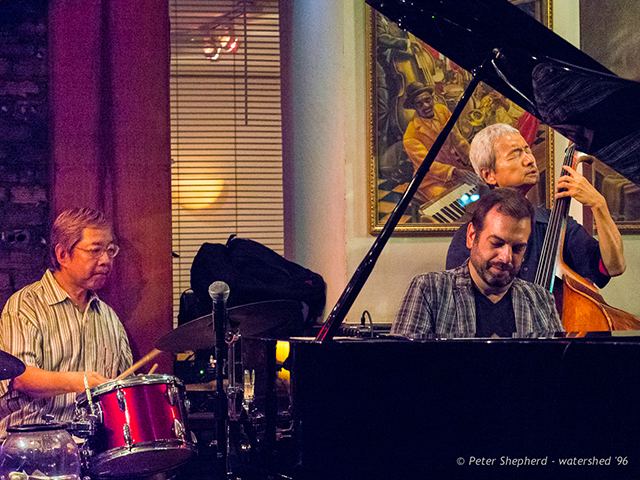
The Marc Devine Trio (Photo: Peter Shepherd)
Devine has a knack for finding the swing that lies under the melody in the unlikeliest places, as on Gerry Goffin and Carole King's "Will You Still Love Me Tomorrow," which, in Devine's hands doesn't sound anything like a Shirelles tune but swings nonchalantly in a manner that is reminiscent of Oscar Peterson or Erroll Garner. Similarly, Elvis Presley's ballad, "Love Me Tender," is another seemingly odd choice that somehow works perfectly when taken at an ultra-slow pace that renders it almost minimalist. Osie Johnson's "Osmosis" is the exact opposite: as vertiginous as it gets on the album, this is an extremely appropriate closer that leaves the listener hungry for more. In short, Marc Devine's debut album at the helm of his trio lives up to its title, and with its right doses of swing and bop, the excellent rapport between the musicians, and the variety of the tune selections, it's one of the best and most engaging trio albums I've heard in a very long time.
Further Information
For more information about the Marc Devine Trio, including upcoming live gigs, please visit Devine's website here.
Despite the size and depth of his recorded output, forty years after his passing on a golf course in Madrid, Spain, Bing Crosby is still mostly remembered by the general public for his holiday recordings, especially the many he made for Decca Records between the 1930s and 1940s. These are classic readings of tunes that have become popular Yuletide standards, such as "I'll Be Home for Christmas," "It's Beginning to Look a Lot Like Christmas," and most of all, Irving Berlin's "White Christmas." Several years ago I wrote about these here.
Malcolm Macfarlane, co-editor of the ICC's BING Magazine
As the holiday season approaches, I've had the chance to sit down with my friend Malcolm Macfarlane, British co-editor of BING Magazine, the journal of the International Club Crosby, to discuss at length the importance of Crosby's Christmas output. On this new episode of the Jazz Flashes Podcast, Malcolm and I cover Bing's classic Decca sides, but we also delve into his holiday movies (1942's Holiday Inn and 1954's White Christmas), Christmas radio and television specials, and other holiday albums he made in the 1960s and 1970s, including I Wish You a Merry Christmas (1962) and A Time to Be Jolly (1971). All of these are the perfect records to get in a holiday mood Crosby-style. If you're interested in listening to our whole 75-minute program, it's available at the end of this post.
Like every year, Jazz Flashes would like to wish our entire readership around the world the happiest (and jazziest) of holidays! Thanks for your attention!
Singer Frank D'Rone is perhaps one of the most obscure but definitely one of the most swinging vocalists of the 1950s and '60s. When he passed away in 2013 at age 81, his obituary in the Chicago Tribune noted that on the day he gave his last concert, he "didn't know whether he should go to the emergency room or the concert hall." Such was D'Rone's devotion to music. Born in Massachusetts in 1932 but raised in Rhode Island, D'Rone developed an early interest in the guitar, and by the early '50s he was making a name for himself in jazz clubs around Chicago, both as a singer and as a guitarist. Nat King Cole was particularly impressed by D'Rone's musicianship, to such an extent that he took the younger singer under his wing and helped him get a recording contract with Mercury.
In his book Jazz Singing, critic Will Friedwald observes that "D'Rone has a forties-type voice . . . in a fifties Capitol F[rank] S[inatra] setting . . . and generates genuine warmth" (331). This Sinatra connection is particularly evident in the album After the Ball, recorded in 1960, partly because the vivacious arrangements are by Billy May. The twelve songs on the LP are loosely tied by the concept of an imaginary conversation between two lovers who have just attended a dance. Perhaps not enough to speak of a concept album in the strict sense of the term, but the set works extremely well because both the songs and the charts are top notch, and the tracks range from a high-octane swinging reading of an old chestnut like Charles K. Harris's "After the Ball" to versions of well-known standards such as "My Melancholy Baby" and Cole Porter's "You'd Be So Nice to Come Home to," and even more contemporary tunes like Bart Howard's "Let Me Love You" and Matt Dennis's excellent "Will You Still Be Mine." Whether he's singing an all-out swinger or a longing ballad, the warmth of D'Rone's voice shines through as he, according to the anonymous liner notes, "re-lives the whole early-morning romance vocally." This is most definitely an album in need of rediscovery, and so is the name on its cover—Frank D'Rone.
A recent post about tenorist Spike Robinson in Marc Myers's blog JazzWax made me dust off my Robinson records and enjoy them all over again after several years. And I have many, all of them wonderful, because as Myers rightly says, "there are no bad Spike Robinson recordings." Born in Kenosha, WI, in 1930, Robinson didn't pursue a full-time career as a jazz musician until he was in his fifties. His job as a mechanical engineer paid the bills, and he simply played occasionally at nights in Colorado, mostly in the Boulder and Denver areas. He'd begun on alto saxophone and clarinet but later switched to tenor, and his playing was cast in the Four Brothers mold of Al Cohn, Zoot Sims, and Stan Getz. Robinson had a knack for ballads, but no matter what he plays, his warm tone always shines through. While in the Navy in the 1950s, he found himself in England, where he collaborated with some of the best British jazz musicians of the time, such as Victor Feldman and Johnny Dankworth, and where he even got to make his first records. Upon his return to civilian life in the United States, Robinson settled into his job as an engineer and wouldn't record again until about three decades later. His tours of the United Kingdom and other European countries in the 1980s created such a stir that he decided to quit his job and move there, making constant live appearances and recording quite prolifically for a variety of labels such as Capri, Hep, and Concord. Robinson passed away in England in 2001 at age 71.
Guitarist Mundell Lowe
One of my favorite albums by Robinson, Reminiscin' (Capri Records, 1992), captures him live at the Jazz Works in Denver in December 1991, in the company of guitarist Mundell Lowe, bassist Monty Budwig (one of his last appearances on record), and drummer Jake Hanna. This pianoless quartet setting brings out the Getz-like qualities of Robinson's playing, and both dates (December 12 and 15) find him exploring the higher registers of the tenor saxophone. The eight selections (all of them standards plus a bluesy original by Robinson) clock in at over six minutes, with plenty of opportunities for everyone to show their skills, particularly the leader and Lowe, who engage in long solos with the strong support of Budwig's bass. There are a quite a few peppy mid-tempo numbers, like the opener, "Dancing in the Dark," "The Girl Next Door," "Yours Is My Heart Alone," and a charming, Latin-flavored reading of "Without You." The excellent ballad "My Silent Love" is taken at a faster tempo than usual, but the album also showcases Robinson's breathy, Lester Young-influenced approach to slow tunes on Cole Porter's "Dream Dancing" and Rodgers and Hart's "Where or When." The album closer, Robinson's own "Blues for Sooz," is the perfect vehicle for the quartet to effortlessly delve into the blues idiom and simply have some fun playing together. Though rather forgotten today, Spike Robinson is one of the best saxophonists of the 1980s and '90s and deserves to be heard because he indeed never made a bad album.
French-born American jazz pianist Roger Davidson has spent his whole career dabbling in several different kinds of music, from Caribbean to tango to classical. But his true passion, both personally and musically, has always been Brazil, as we can infer from his latest album, Oração para amanhã/Prayer for Tomorrow (Soundbrush Records, 2017). Davidson was born in Paris but soon moved to the United States and settled in the northeast, where he has been performing throughout his life. His music, always inventive and eclectic, has merited the enthusiastic approval of renowned jazz critics such as Will Friedwald, who has written that Davidson's new record features "brilliant musicians [and] great music."
Hendrik Meurkens
Davidson, who started his own label, Soundbrush, as an outlet to release different types of music that he enjoys and is passionate about, is surrounded here by some of the best Brazilian musicians on the current New York scene. Recorded live at NYC's Zinc Bar over the course of several dates in May and October 2016, the album finds Davidson in the company of his new trio—bassist Eduardo Belo and drummer Adriano Santos. The addition of the German-born Hendrik Meurkens on harmonica and vibraphone is welcome indeed, particularly since it brings variety and class to the proceedings with the inclusion of an instrument, the harmonica, that one doesn't get to hear often enough on jazz records these days.
The album showcases twelve of Davidson's new Brazilian-styled compositions whose freshness and diversity of rhythms and approaches always keep the listener interested. The interplay between the four participants is flawless and always full of little surprises here and there, and Meurkens's vibraphone and harmonica blend perfectly well with the overall sound of the trio, making it fuller and more attractive. Prayer for Tomorrow is a welcome addition to the catalog of Davidson's Brazilian outings (The 2003 Richard Rodgers songbook Rodgers in Rio is another good example of what the pianist can do with Brazilian rhythms) and will definitely leave the listener longing for more. Fortunately, Davidson is already working on more music in a similar vein with this same trio. A few weeks ago, Davidson joined us from a French restaurant in New York for a new episode of the Jazz Flashes Podcast. You may listen to the whole conversation, which was extremely interesting despite some minor technical issues, here:
Though perhaps he isn't as well remembered today as his achievements deserve, the career of North Carolina piano man Billy Taylor was full of milestones: in the 1950s he worked as house pianist at New York's Birdland; in the 1960s he became the first black musical director of a major network television program, on the popular David Frost Show; and in the 1970s, he earned a doctorate in music from the University of Massachusetts. Taylor was also very involved in spreading the good news about jazz on the radio and on television, but he always found time to play live and enter the studio regularly for over fifty years, recording a respectable amount of albums for labels such as Prestige, Savoy, Impulse, and Capitol, among others. Born in Greenville in 1921, Taylor moved to NYC in the early 1940s playing and sometimes recording alongside great jazzmen like Slam Stewart, Ben Webster, and violinists Stuff Smith and Eddie South. While working at Birdland, he formed his first trio, the setting in which he felt most comfortable throughout his career, and cut his first of many records as a leader. Taylor passed away in New York in 2010 at age 89, leaving behind a solid musical legacy that's in need of rediscovery.
Those who have criticized Taylor for not being innovative enough should listen closely to what I consider to be his best album—My Fair Lady Loves Jazz, recorded for Impulse in NYC over the course of three separate sessions in January and February 1957. This was at a time when the successful show by Alan Jay Lerner and Frederick Loewe had been running on Broadway for about a year, and in fact, there was even a release party for the LP that was attended by most of the theatrical cast. Taylor's trio features bassist Earl May and drummer Ed Thigpen, but it's augmented for this project by several excellent horn players like trumpeter Ernie Royal, baritone saxophonist Gerry Mulligan, altoist Tony Ortega, and trombonist Jimmy Cleveland, to mention just four. The horns, arranged by none other than Quincy Jones, are a perfect complement for the elegant sound of Taylor's trio, which they enrich greatly. This is evident from the very first bars of the opening track, "Show Me," which also features Royal on trumpet prominently, and the rest of selections always leave room for solos by Taylor and his guests—Ortega shines on the ballad "I've Grown Accustomed to Her Face" and Cleveland contributes a fine solo to the bouncy "Get Me to the Church on Time," for instance. Jones's charts underscore the jazz elements of great tunes like "I Could Have Danced All Night" and "On the Street Where You Live" without straying too far away from the melodies, and Taylor obviously feels extremely comfortable in the company of May and Thigpen, for whom he only has words of praise in the liner notes. The result is classic, boppish Taylor, a thoroughly satisfying album that serves as the perfect introduction to his music. Other jazz treatments of My Fair Lady, like those by Shelly Manne (for Contemporary, 1956, with André Prévin and Leroy Vinnegar) and Chet Baker (his 1959 Lerner & Loewe songbook for Riverside), may be better known, but Taylor's approach to that memorable musical is one of the most interesting ever recorded.
Here's the second installment of the brief two-sentence reviews of jazz records that I heard during my recent European trip and that I originally published in my Facebook page. The Modern Jazz Quartet at Music Inn, Vol. 2 (Atlantic, 1959) Recorded live in Lenox, MA, in the summer of 1958, this date showcases the usual elegance of the forward-thinking Modern Jazz Quartet along with tenorist Sonny Rollins on two tracks (on Vol. 1, recorded two years earlier at the same place, it's Jimmy Giuffre that guests). The carefully chosen set list works perfectly, mixing standards with tunes by John Lewis, Milt Jackson, and Charlie Parker, and the two tracks with Rollins ("Bags' Groove" and "Night in Tunisia") are the highlights of an album that is superb all around.
Oscar Peterson Trio + One (Mercury, 1964 / Verve, 2007) Cut for Mercury in 1964, this is one of Oscar Peterson's most relaxed, bluesiest dates of the 1960s, featuring a special guest in trumpeter Clark Terry, who plays both flugelhorn and trumpet. Peterson's piano playing is characteristically dazzling, as usual, and the comfortable interplay between his trio (Ray Brown on bass and Ed Thigpen on drums) and Terry is a joy to hear, making this an essential entry in Peterson's vast, rich discography.
Jan Lundgren Trio—Svenska Landskap (Sittel, 2003 / Fog Arts, 2017) This 2003 gem now available for digital download and streaming finds Jan Lundgren and his trio (Mattias Svensson on bass and Morten Lund on drums) on a musical journey around Sweden via jazz versions of traditional tunes and a couple of very appropriate Lundgren originals. The playing is swift and fresh on the uptempo tracks and lyrical and introspective on the ballads, and the album as a whole won't disappoint anyone who takes a chance on it. [You may read a more detailed Jazz Flashes review about this album here.]
Freddie Hubbard—Born to Be Blue (Pablo, 1982) This is a lovely, very recommendable late-career album by trumpeter Freddie Hubbard in a percussion-laden sextet that also features the great Harold Land on tenor sax and flute. It features some very engaging uptempo numbers (like "Joy Spring," for instance) and some typically sensitive, lyrical ballad playing such as the beautiful title track.
Due to a recent trip to Europe, I haven't had the chance to publish anything in Jazz Flashes, but I did write some very brief reviews of jazz albums I heard and/or purchased while overseas on my Facebook page. Now that I am back, I have compiled these two-sentence reviews on this post. I hope you find something to your liking among these outstanding records—and stay tuned for the forthcoming second part! Buddy Tate and His Buddies (Chiaroscuro, 1994) Saxophonist Buddy Tate's buddies—trumpeter Roy Eldridge, saxist Illinois Jacquet, pianist Mary Lou Williams, guitarist Steve Jordan, bassist Milt Hinton, and drummer Gus Johnson—are mostly jazz royalty, musicians who feel at ease in each other's company and enjoy playing together. This powerful, blues-drenched 1973 New York City date is truly a masterclass in first-rate small-group swing and blues, five selections that give all participants plenty of room to shine and surprise the listener with their inventiveness and exciting knack for improvisation.
Emil Viklicky—Live at the Box (Petr Bielicky, 2014 / Fog Arts, 2017) Always the experimentalist, Czech jazz pianist Emil Viklicky feels at home distilling a mixture of jazz, classical, and Moravian folk music, as he does in Live at the Box, recently reissued for digital download and streaming by the Stockholm based Fog Arts label. This 2011 live date finds Viklicky in a trio setting, with Frantisek Uhlir on bass and Josef Vejvoda on drums, running through a varied selection of his highly personal compositions, the kind of eclectic jazz that surprises and grows on the listener with each play, with the highlight being bassist Uhlir's "Father's Blues."
Gerry Mulligan & Scott Hamilton—Soft Lights and Sweet Music (Concord, 1986) Though perhaps not as well known as it deserves to be, this is a memorable tenor-baritone saxophone meeting between Scott Hamilton and Gerry Mulligan, cut in the mid-1980s for Concord in a quintet setting with Mike Renzi on piano, Jay Leonhart on bass, and Grady Tate on drums. It's a mostly uptempo affair with a fair share of Mulligan originals, and the mutual understanding between both saxophonists makes for some extremely satisfying listening.
Howard McGhee—Maggie's Back in Town (Contemporary, 1961) After quite a spell away from the studios due to drug-related problems, trumpeter Howard McGhee came back on the jazz scene with this amazing album that showcases his bop-inflected playing in the company of fantastic musicians like pianist Phineas Newborn, Jr., bassist Leroy Vinnegar, and drummer Shelly Manne. The result is one of the best bop records of the early 1960s, an inventive, exciting run through a few standards, an original composition by McGhee, and two Teddy Edwards tunes, all of which makes it clear that Maggie (as McGhee was known to his friends) was definitely back!
Rochester-born jazz discographer, historian, and musician Noal Cohen first heard the sounds of jazz at a very early age and was instantly hooked. And even though there were other interests in his life, he has devoted a big part of his time to listening to, playing, and studying this music, particularly the bop and hard bop of the 1950s and '60s. Now that he's retired and lives in Montclair, NJ, he has undertaken several important projects. One of them is his website, Noal Cohen's Jazz History Website, which features thorough, painstakingly researched discographies of jazz greats such as Gigi Gryce, Johnny Hartman, Elmo Hope, Lucky Thompson, Frank Strozier, Teddy Charles, and Herb Geller, among others. The site is also a treasure trove of LP covers from his extensive jazz record collection and information about the 1950s Rochester, NY, jazz scene, which was extremely active. His other project is a book he has co-authored with his friend Michael Fitzgerald—Rat Race Blues: The Musical Life of Gigi Gryce, the definitive Gryce biography, which has already reached its second edition.
I recently had the chance to chat with Noal about his life, his invaluable work as a jazz historian and discographer, and his personal views on jazz and its history, when he guested on the sixth episode of the Jazz Flashes Podcast. During our lengthy conversation, which ended up lasting for about two hours, Noal and I discussed his excellent Gigi Gryce biography (which he had already written about a few months ago in The Vintage Bandstand, here), his laborious discographical research on some lesser-known jazz greats from the '50s and '60s, his own work as a jazz drummer, and the many reasons why the Eisenhower years can be considered a golden era of high-quality jazz, among several other topics. I'd like to thank Noal for guesting on the podcast and for his time; our conversation was quite a thrill for me, and if you are interested in listening to it, you may access it in its entirety here: